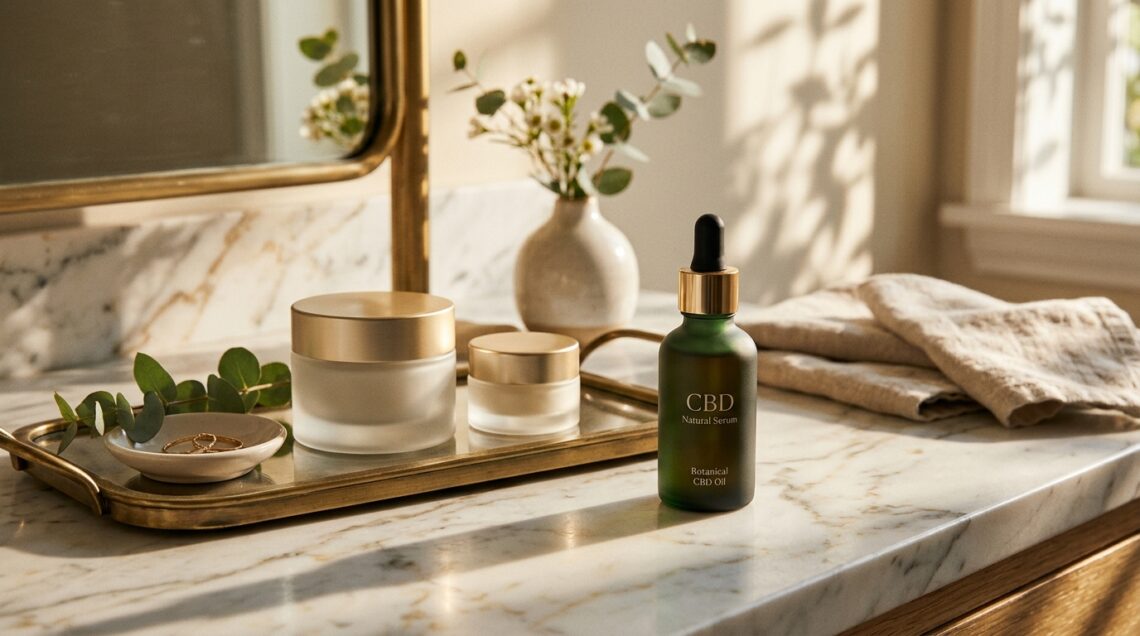
Skin care shelves now carry serums, balms, and creams that list cannabidiol near the top of the label. Interest is easy to explain: skin has its own cannabinoid receptors, and early lab results sounded promising. Using CBD oil on the face or body still raises more questions than it answers, and a careful routine matters more than a trendy ingredient.
What Skin Research Shows
Cells and receptors
Skin cells, including those in the oil-producing sebaceous glands, carry cannabinoid receptors and the enzymes that handle the body’s own cannabinoids. That finding has drawn dermatology researchers to the topic.
A 2014 study in the Journal of Clinical Investigation, led by Attila Oláh, tested CBD on cultured human sebaceous gland cells. CBD reduced lipid production, slowed cell growth, and showed anti-inflammatory effects. It also kept a pro-acne agent from boosting oil output. All of this happened in cells in a dish, which is a long way from a face in a mirror.
Acne in context
Acne is the most common skin condition in the United States, affecting up to 50 million Americans a year, according to the American Academy of Dermatology. It involves excess oil, clogged follicles, bacteria, and inflammation working together. That is why the 2014 sebaceous gland findings drew attention: oil and inflammation are two of the four pieces. A single lab result on one piece of the puzzle does not amount to an acne treatment.
Human studies
Human data is thinner. A 2019 study in the journal Clinica Terapeutica followed 20 patients with psoriasis, atopic dermatitis, or scars. Participants applied a CBD-enriched ointment twice a day for three months, and the researchers reported improvements in measures of skin condition. Twenty people with three different conditions is too small a group to settle anything, though it was enough to justify larger trials.
Proven treatments already exist for common problems. For acne, dermatology guidelines rely on benzoyl peroxide, topical retinoids, and, for some patients, antibiotics or other prescription options. CBD has not replaced any of them.
Getting through the skin
CBD’s molecular weight is about 314 daltons, small enough in principle to cross the skin’s outer layer. Its extremely oily nature works against it. The layers beneath are water-rich, so a highly oil-loving molecule moves through them slowly. Formulation matters: the carrier, the other ingredients, and the concentration all affect how much CBD ends up where.
| Claim | Basis | Strength of evidence |
|---|---|---|
| Reduces oil production | Cultured sebaceous cells (2014) | Early, lab only |
| Calms redness and irritation | Lab data, small human reports | Limited |
| Improves scars or eczema | 20-patient study (2019) | Preliminary |
| Treats acne | Few controlled human trials | Unproven |
Marketing claims versus findings
Terms such as “clean beauty,” “dermatologist tested,” and “clinically proven” appear on skin products without a single standard behind them. “Tested” says a test occurred, not that the result was good. Results from tests on the finished product itself, with the study design described, carry far more weight than a badge.
Reading a Skin Care Label
Ingredient names on cosmetics follow a standard naming system, and the words matter.
- “Cannabidiol” means CBD is present
- “Cannabis sativa seed oil” or “hemp seed oil” comes from seeds and contains essentially no CBD
- “Cannabis sativa leaf extract” or “hemp extract” may contain CBD, but the label should say how much
Hemp seed oil can still be a good moisturizing ingredient. It just is not a CBD product, and a jar that advertises hemp while listing only seed oil is selling a different thing. The reliable check is the cannabidiol line and a milligram amount.
What to check before buying
- CBD amount per container in milligrams, since there is no standard concentration
- Other ingredients, especially fragrance, essential oils, and alcohol, which irritate some skin
- Packaging that protects against light and air, such as opaque tubes or airless pumps
- A batch-specific lab report that confirms potency and checks for contaminants
- A statement about THC content
- Claims that stay within cosmetic territory
That last point deserves a closer look. The FDA does not approve cosmetics before they reach shelves, but it draws a line at claims. A product that says it moisturizes or soothes is a cosmetic. A product that says it treats acne, eczema, or psoriasis is making a drug claim, and the agency has sent warning letters to companies for that kind of language. A jar that promises to cure a skin disease is a red flag.
Can the dropper oil go on skin
Many people wonder about using the bottle of CBD oil meant for swallowing. It is not harmful by default, but it was formulated for the mouth. Flavorings such as mint or citrus oils can irritate skin, and the texture is rarely designed for the face. A product made for skin usually pairs the CBD with ingredients chosen for the job.
Carrier oils and clogged pores
CBD skin products blend the extract into a base such as MCT oil, jojoba, squalane, shea butter, or hemp seed oil. People with oily or acne-prone skin sometimes find that heavy oils clog pores. Comedogenic ratings, which score oils by their tendency to clog, are rough guides built on limited testing, and individual response varies. The patch test is more informative than the rating.
Sensitive skin
Allergic contact reactions usually trace back to fragrance, essential oils, or preservatives, though botanical extracts, hemp among them, are reported occasionally. Fragrance-free versions are an easier place to start for sensitive skin, and a short ingredient list leaves fewer suspects if a reaction appears.
Body balms and sore muscles
Balms and rubs for muscles are a separate category. Many include menthol, camphor, or capsaicin, which create cooling or warming sensations on their own. The massage itself also feels good. Without a controlled comparison, it is hard to say how much relief comes from CBD, and a product that seems to work may be working because of its other ingredients. Trials specific to topical CBD for muscle soreness remain limited.
A Careful Way to Try It
Cosmetics rarely get the same attention as medicines, so a cautious routine protects the skin. A sensible order:
- Patch test first. Apply a small amount to the inner forearm or behind the ear once or twice a day for several days. Redness, itching, or swelling means the product is not a fit.
- Add one new product at a time. Starting a CBD serum alongside a new retinoid and a new cleanser makes it impossible to tell which one caused a reaction.
- Use it on clean, dry skin, with moisturizer as the following step if the product is a serum. Nighttime works well for most oils.
- Keep sunscreen separate. CBD does not protect against ultraviolet light, and a daily broad-spectrum sunscreen still does the heavy lifting in the morning.
- Give it time. Skin renews itself roughly every four weeks in younger adults and more slowly with age, so four to eight weeks is a fairer test than four days.
- Stop if burning, rash, or hives appear, and see a dermatologist for problems that persist.
A simple skin diary makes the trial easier to judge. Take a photo in the same light each week, note any new products, and write down flare-ups, stress, and sleep. Skin changes for many reasons, and without notes it is tempting to credit the newest product for a good week or blame it for a bad one.
Topical products are meant to stay on the skin. They are not made to be swallowed, and they should stay off broken or heavily inflamed skin unless a clinician approves. People who are pregnant or nursing, or who take prescription medicines, can ask a doctor or pharmacist before adding any new product.
Storage and shelf life
Light and heat degrade cannabinoids, so storage matters. Cosmetics often carry a period-after-opening symbol, an open jar icon with a number and the letter M, showing how many months the product stays good after the seal is broken. Keep jars out of hot cars and sunny windowsills. A shelf beside the shower is also warmer and more humid than it looks.
Price and value
Price per milligram of CBD is a poor guide for skin products, since the base ingredients, the packaging, and the formula do much of the work. A higher concentration does not guarantee a better result. A fair price covers a tested batch, stable packaging, and a formula built for skin.
The new THC rules
Federal hemp rules are shifting. As reported through late September 2026, finished hemp products above 0.4 mg of total THC per container were scheduled to lose federal hemp status on December 11, 2026. Analysts have said that topical and cosmetic products that stay under the limit should remain compliant. A product with a lab report that shows total THC is easier to trust.
Final Thoughts
CBD oil on the skin has an intriguing lab background and a thin human record. Small studies report encouraging results, and proven treatments for acne and eczema still come first. A careful label read, a patch test, and a patient trial period protect the skin better than any marketing claim. A dermatologist is the right call for persistent problems.